Tuesday, March 30, 2021

NCAA Dropping the Ball on Gender Equality in Basketball

Gender discrimination in sports is a hotly debated topic at both the college and professional levels for a variety of reasons. Women’s teams are consistently given less media coverage, fewer resources, and less encouragement to participate in athletics. Despite the pledge to support equality, the organizations that sponsor sporting events do not appear to value female athletes in the same way as they do male athletes, something that was glaringly apparent during the NCAA basketball tournament.

Gender policy in sports: a brief history

Many of the policies that regulate gender and sports originated in Title IX. Title IX was one of the first policies that established that both men and women deserved access to equal opportunities in education. Since sports are a quintessential part of the American college system Title IX was quickly tied into athletics. At the time of Title IX’s passage, women had to fight for the right to play their sport. Women emphasized their female bodies as they protested for women to be allowed to play on teams and receive school support. Biological sex was immediately brought into the debate as politicians, schools, and athletes considered whether women had the same abilities as men in sports and how equality would be measured. This focus on biological sex resulted in rhetoric that differentiated the “female athletes” from the regular “athletes,” or their male counterparts. 


Although Title IX successfully integrated women into the educational sphere with men, it continued to segregate sports by sex. Even though it helped bring greater equity to the resources available to women including equal scholarship funds and numbers of teams, the creation of women’s teams perpetuated the idea that men have physical dominance over women and that women would be unable to compete at the same level as men.


How does the NCAA come into play?

One of the biggest controversies in women’s sports in past weeks has been the handling of the NCAA basketball tournaments. The NCAA is a nonprofit organization that sponsors college athletics throughout the country. While the NCAA does not enforce Title IX it requires that the schools involved have gender equity plans. The players in the NCAA are not paid and the expectation is that equal resources are allocated to the men’s and women’s teams. Some of the implications of this are that there are equal numbers of men and women’s teams at universities and that these teams have equal funding. However, this is not always the reality of the situation.


This year the NCAA men's and women’s March Madness tournaments were played in two different cities at the same time due to COVID-19. Extra precautions were in place to help protect players from COVID-19 and efforts were made to create a sort of bubble. However, the differences between the facilities and resources that men and women’s teams were given were shocking. One of the female players’ tweets went viral showing an understocked weight room and lack of space to workout. This was a stark comparison to the fully decked-out men’s weight room.
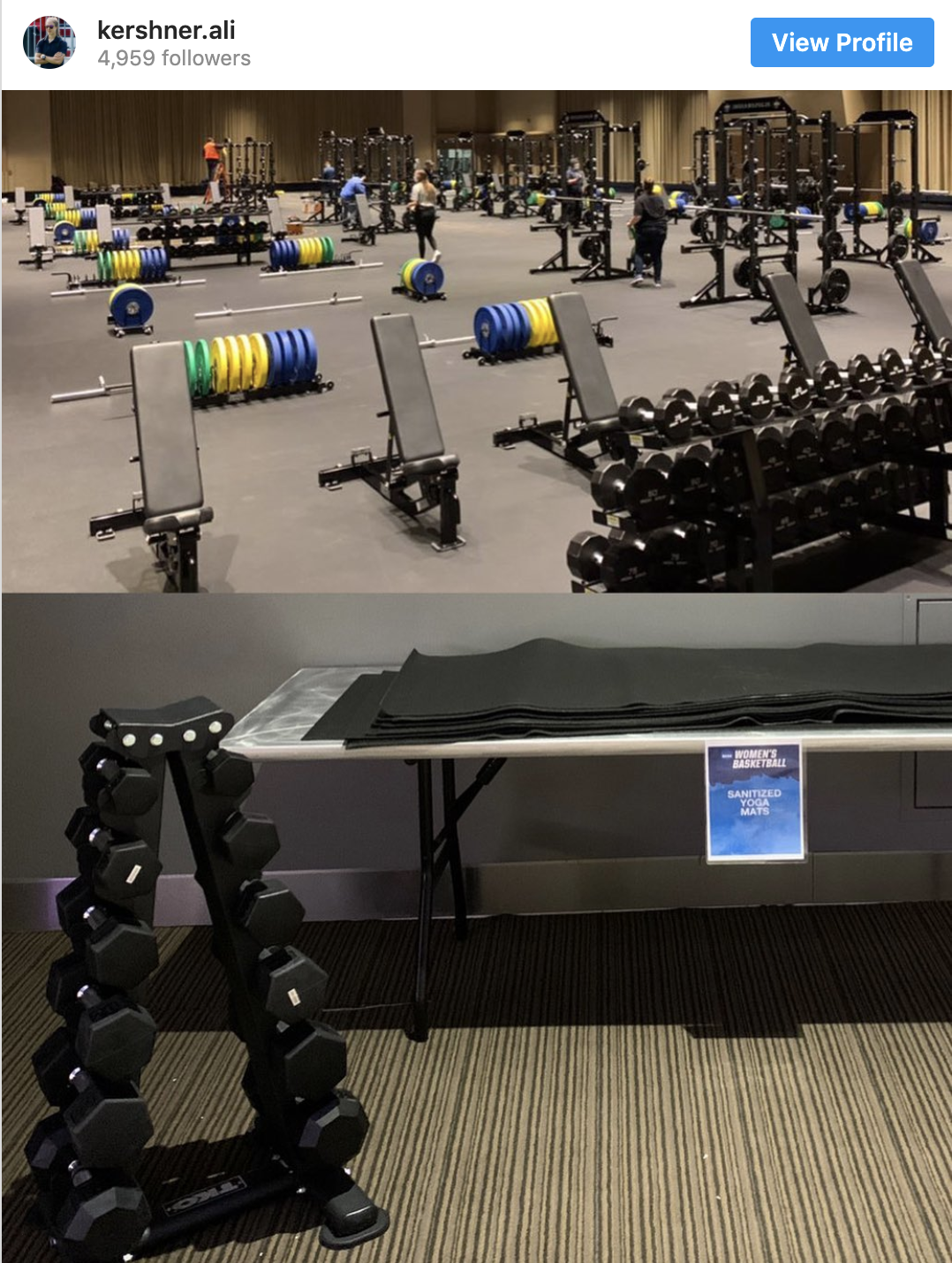

The differences did not end there though. Photos later revealed the difference in the size of swag bags given to female players, the quality of food, and the lack of accurate COVID-19 testing. Female players were outraged by the clear lack of planning and thought given to their tournament and many took to social media with their grievances where their posts went viral. Millions of people were able to view and comment on the obvious inequity between men’s and women’s basketball. 


In response to the criticism, the NCAA offered an apology for the lack of planning and consideration for female players, but this did not make up for the shortsightedness in supporting female athletes. Georgia Tech women's basketball coach Nell Fortner commented, “Thank you for using the three biggest weeks of your organization's year to expose exactly how you feel about women’s basketball--an afterthought.”


These discrepancies at the NCAA tournament highlighted only some of the visible inequities in women’s sports. Sharrow, an academic who has written extensively on gender and athletics wrote “the absence of routine media coverage sends a troubling message that women’s athletics are less exciting, less competitive, and less worthy of resources than their male counterparts.” Because women receive less time on the air they have lower viewership which in turn means they make less money. This subliminal messaging has an impact on female athletes and their ability to succeed in their careers as professional athletes. Making a career out of basketball is significantly less plausible when wages are low, the average salary being $75 thousand per year. This is in contrast to NBA players who make an average salary of $7 million. Furthermore, these athletes are not given the same validation for their athletic abilities in spite of being equally qualified.


There is no clear answer to how women can gain equal footing with men in sports. There have been many suggestions however including increasing the percentage of WNBA revenue that is paid to its players, increasing media coverage of women’s sports, and coordinating events with men’s teams to ensure equal treatment. However, it is clear that systematic change will be necessary to change the culture of sports in America.


NCAA Weight Rooms and the Question of Title IX/Inequality

Background 


During NCAA’s March Madness tournament and a little over a week ago, Sedona Prince, an NCAA women’s collegiate basketball player from The University of Oregon, posted a viral video of the women’s weight room provided for by the NCAA in comparison to the men’s weight room in San Antonio.


Clearly, the women’s weight room consisted of yoga mats and a single dumbbell rack; meanwhile, the men’s weight room included a variety of weights, machines, dumbbells, and exercise racks. In response to this glaring mistreatment of the women’s basketball teams by the NCAA, NCAA’s vice president of women’s basketball Lynn Holzman released a statement which mentioned that the limited amenity access for the women’s teams would have typically been available, but as a result of “limited space…the original plan was to expand the workout area once additional space was available.” Following this press release by Holzman, numerous individuals and participating teams refuted Holzman’s rationale and showed (through photos and videos) that additional space surrounding the women's facilities was available. In the following days, NCAA President Mark Emmert was quoted as saying that “the NCAA will continue to aggressively address material and impactful differences between the Division I Men’s and Women’s Basketball Championships…while many of the operational issues identified have been resolved, we must continue to make sure we are doing all we can to support gender equity in sports.” While many view this treatment between men’s and women’s basketball programs by the NCAA as an economic issue, or that NCAA Tournament financing should be appropriated to men’s and women’s teams based on their revenue shares, these recent events point to a historically relevant problem - Title IX and the issue of inequality in education and sports. 

Title IX and Continuing Inequalities 


In review, Title IX is a federal civil rights statute which was instituted in 1972 to ensure that “no person in the United States shall, based on sex, be excluded from participation in, be denied the benefits of, or be subjected to discrimination under any education program or activity receiving Federal financial assistance.” In short, Title IX protects individuals and students from discrimination based on sex and is applicable to federally funded or financed educational and sporting institutions. More specifically, according to Cecilia Townes, a contributor at Forbes, “Title IX requires college institutions (among other entities) to provide equitable access and resources to its men and women who choose to participate in college athletics. While this doesn’t mean that schools have to provide an equal amount of scholarships or spend the same amount of money on men’s and women’s sports, it does mean that there cannot be disproportionate access and support for men’s and women’s sports.” Since 1972, Title IX has been, for the most part, a constructive social-political federal statute that has promoted an unapparelled level of equality between the sexes – especially through improving the parity of support for all collegiate sports teams. Because of this, Elizabeth A. Sharrow, author of “Sex Segregation as Policy Problem: A Gendered Policy Paradox” is quoted as saying that a “majority of average Americans…express increasingly high levels of support for the law as applied to athletics.” However, while Sharrow dictates unanimous public support for the many benefits of Title IX, she also expresses skepticism by saying “the policy remains unevenly implemented across athletic departments such that men and boys persistently enjoy greater athletic participation opportunities, the political battle towards achieving equality should focus on better enforcing the policy as currently designed.” Sharrow’s skepticism illuminates another problem as per the enforcement of Title IX’s policies – in practice, and according to federal law, any educational and sporting institution that receives federal financing and assistance is inherently subjected to compliance with Title IX’s policies. But the question still remains, is the NCAA (who receives monetary financing from a large number of member schools and universities) subject to Title IX policies and statutes? According to the federal court case NCAA v. Smith in 1999, Supreme Court Justice Ginsburg concluded that “the Association’s receipt of dues demonstrates that it indirectly benefits from the federal assistance afforded its members, which without more, is insufficient to trigger Title IX coverage.” Upon the analysis of NCAA v. Smith, two things can be inferred. First, the NCAA is not, according to federal law, responsible for any implicit biases, prejudices, or acts of discrimination against women and women’s sports teams. Second, despite many of the benefits that Title IX has contributed to the collegiate sports world, there is still significant disparity and inequalities between women’s and men’s sports teams. 

Conclusion and Implications


The disparity in workout equipment, funding, and support provided to the men’s and women’s sports teams at the Division I NCAA March Madness Tournament can be explained by the continued inefficiencies of Title IX, in addition to the long-standing inequalities between men and women in present-day society. Federally supported statutes like Title IX that enable private institutions like the NCAA to discriminate (through loopholes) against women’s athletic teams is eminent of the bigger inequality problem. Simply recognizing the inequitable treatment of men’s and women’s workout facilities and associated amenities by the NCAA may not provide a suitable and sustainable solution to the inequality issue as a whole, nor in the case of the NCAA. So, what can be done? Well, the issue could be fixed at the federal level. First, as effective as Title IX has been for the last fifty some-odd years, there could still be room for improvement. Fixing loopholes that exclude private and nonprofit organizations (who still receive implicit funding from the government) from being subject to anti-discrimination policies, like the NCAA, could be a good place to start. Second, the question of inequality is not about instituting equal outcomes among the sexes, it is about simply providing equal levels of opportunity; therefore, when an organization (like the NCAA) is found culpable of treating men and women unequally, sufficient consequences may need to be enacted, because short-term public relations issues are not suitable solutions for fixing the issue of inequality.

The White House Promotes Transgendered Women Playing in Female Sports

 Background


         On January 20th, 2021 President Biden signed an executive order that promoted the equality of everyone, regardless of their gender identity or sexual orientation. This executive order states that “Children should be able to learn without worrying about whether they will be denied access to the restroom, the locker room, or school sports.” While the executive order does not explicitly say that it was expanding Title IX to include transgendered women in female sports, many however drew upon the connection and soon became very concerned. A reporter asked Jen Psaki, the White House Press Secretary, what council the White House would give to K-12 schools in light of the executive order Biden had just signed. Jen Psaki responded by saying, “The president’s belief is that trans rights are human rights, and that’s why he signed that executive order.” 


Transgender sports debate polarizes women's advocatesIt has been assumed, while not explicitly stated, that schools may lose federal funding for not allowing transgendered women to play in female sports, because it would be a violation of Title IX. Therefore, according to Freedom for all American, around 20 anti-transgender sports bills currently across the United States. This is the mere beginning of a much larger problem, for both sides of the debate have important attributes to them. One side argues, as does the three girls who filed a federal discrimination complaint against Colorado over consistently losing to transgendered females, that allowing biological males to compete in female sports robs the biological women of their training and hard work. However, the other side argues, as does Andraya Yearwood, that being a transgendered women does not take away their love for the sport, and to continue playing with men would be saying they are still male, not the gender they believe to be. Therefore, in order to better understand this topic, it is necessary to analyze a particular issue within this very important question. 


Intersectionality


    Intersectionality is the concept that attributes like one’s race, gender, class, and sexual preference intersect to create further privileges or disadvantages depending on the person’s attributes. For example, a white cis-man will have more privileges and benefits in life than a black transgender woman. The attributes which suffer the most disadvantages are those which break gender norms. Gender norms are the ways in which society has accepted men and women to look and act; therefore, when these rules are broken, those who break them suffer from being seen as the outcasts in society. 

         The difficulty in addressing this problem is that it is dealing with two marginalized groups. The first marginalized group consists of women participating in sports. Traditionally, women are unathletic and focus on looks as opposed to physical capabilities. This is demonstrated clearly in the gender pay-gap that exists in professional sports. An example of this is the Women’s U.S. soccer team who bring in more money than the men’s national team, but still make less money. While there has been a lot of progress for women over the last few decades, there is still a large road ahead of them to become equal with men’s sports.   


         The other marginalized group is more easily identifiable, transgendered female athletes. Roughly 0.7% of the population is transgender, and only a small portion of that group participates in athletics within K-12 or collegiate sports. Andraya Yearwood shows the seriousness of this problem. She is a black high school athlete that runs in track and field; however, she was born a man. Many girls filed complaints against her and spoke out against her to the media because she continually beat all the other girls. While she was able to keep running, there was enough persecution to make her feel as though she shouldn’t try to win because she was robbing the other girls. This led to her falling further and further behind the other girls. 


         Through each of these examples, understanding the concept of intersectionality is crucial to understanding the broader issues at hand. In one area females are being mistreated by society because they are being quantified as less important through their income, all because of gender norms associated with femineity. Allowing biological males to participate in female competitions could put further stumbling blocks on the road for women to becoming equal. With that being said, to do that would necessitate the further disadvantaging of female transgendered athletes, especially in such a volatile part of one’s life. This would be another area in which transgender feel they are not wanted or accepted in society. 


Conclusion


While President Biden’s executive order officially changed nothing in the policy applications of Title IX, it did set values by which states should aspire when implementing Title IX. With this unclarity in what is law and what is recommendation, questioning what is best for everyone is necessary to creating the best world we can. While extremes on both sides of this debate have tried to morph the talking points, it is necessary to focus on the core premise of the question. This core premise focuses on how we as a society can help all people become equal and feel involved. If that is our goal then middle of the road solutions can come to fruition. This is not an article arguing for one policy point of view; therefore, I will not address what those solutions can look like. However, it is important to recognize what each side is arguing and how both sides are dealing with discrimination from their intersectional traits. 

New Zealand Approves Paid Leave for Miscarriage

        Last week, New Zealand’s parliament unanimously approved legislation that provides three days of paid leave to couples who experience a miscarriage or stillbirth at any stage of pregnancy. With this decision, New Zealand becomes one of the first countries to allow paid time off following a miscarriage or stillbirth without employees having to use their sick leave. The only other country with legislation of this type is India, but according to this Washington Post article, only those who work at a company with 10 or more people are entitled to these six weeks of paid leave. With much of the population working in the informal job market, this impacts only a small fraction of citizens. 

        Pregnancy loss is something that many women experience at some point in their lives. According to the Mayo Clinic, about 10 to 20% of known pregnancies end in miscarriage. This bill shows support to mothers that experience loss at any time during pregnancy, giving them time to recover mentally and physically. It not only offers financial and emotional support to parents but also encourages more open conversation about miscarriage and stillbirth, which can be uncomfortable to discuss. According to Ginny Andersen, the member of Parliament who presented the bill, “This is a Bill about workers’ rights and fairness. I hope it gives people time to grieve and promotes greater openness about miscarriage. We should not be fearful of our bodies.”

This legislation offers support to women and their opportunities in the workplace. As stated in a New York Times article, “The new law, which had been in development for several years, comes amid a broader global reckoning over women at work. Women have long struggled to balance the requirements of their employers with issues like pregnancy, sometimes leading them to miss advancement and other opportunities.” In this Atlantic article, Slaughter discusses her personal story and attempt to “do it all.” She talks about the way that employers often subtly make it difficult for a primary caregiver to get ahead. She gives an example of an employer considering two equally talented employees, one is a parent, and one spends their free time training for a marathon. The employer is likely to believe that the marathon runner is ferociously disciplined and willing to push himself to reach both work and personal goals. The employer is not likely to believe the same things of a mother who manages many other things on top of getting the same quality of work done. 

        Slaughter argues that a more balanced life in which we rediscover the pursuit of happiness starting with the people we love would be better for us all. This requires changing the culture of work, the same culture that she explains motivated many women she knew climbing the legal hierarchy in New York firms to never admit to taking time off for a child’s doctor appointment or school performance, but instead invented a much more neutral excuse so they would not be discriminated against for a lack of commitment to their work. Slaughter states that by changing the culture “we’ll create a better society in the process, for all women. We may need to put a woman in the White House before we are able to change the conditions of the women working at Walmart. But when we do, we will stop talking about whether women can have it all. We will properly focus on how we can help all Americans have healthy, happy, productive lives, valuing the people they love as much as the success they seek.” 

There is a culture in the world that penalizes employees for having others to care for. There are assumptions made about mothers that make it difficult for them to advance in their careers and balance their family life. This inequality starts even before a child is born. As stated in the Chronicle of Higher Education, there is a discussion about the “baby penalty” that women face in Academia, but there is an absence of discussion on the reality of miscarriage. “The culture of silence surrounding miscarriage adds a further strain to the ability of female faculty members to succeed in academe…we need to recognize that gender inequality starts when a woman tries to have children, not only after she has them.” This applies not only to careers in Academia but to most career fields. 

This type of legislation gives women the power to be honest and talk openly without being penalized or being seen as a less valuable employee. Many have suffered at work in silence so as not to lose credibility or possibility for promotion. There is a reality that someone needs to be responsible for childcare, and this care starts before a child is born, with the physical and mental toll that pregnancy takes on a woman’s body. This legislation passed in New Zealand is a step towards a culture that accepts and talks about parenthood, the female body, and the struggles that women face through miscarriage and pregnancy in general. This creates a culture that is more supportive of women working and being able to balance being a good employee with managing family life. This type of legislation shows that there are things America could do to change the culture of support for family and for women in the workplace.

The Second Wave: How the Pink Tide of 2018 Turned Red in 2020

The “Pink Wave” came crashing into the United States House of Representatives during the 2018 midterm elections, bringing with it a net gain of 14 women in the chamber. However, this influx of women was not split evenly between Democrats and Republicans: Democrats added a net of 24 congresswomen to their ranks while Republicans lost a net of 10. With the number of Republican female congressional nominees in the preceding elections hovering around 50, 2018 saw no significant increase at 52 Republican women winning the nomination in their districts. On the other side of the aisle, the number of female Democratic nominees skyrocketed from a record high of 120 in 2016 to a more astonishing 182 in 2018. For the 116th Congress, female Democratic representatives (88) outnumbered their female Republican colleagues (13) by a margin of almost 7:1.
 
For some in Republican congressional leadership, these ratios were just happenstance and not a cause for concern, especially for a party that eschews identity politics and picking candidates based on their physical qualities rather than their devotion to certain ideological positions. For other congressional Republicans, these were staggering statistics that were emblematic of the party’s larger Trump-era electoral problem with women, especially those who are college-educated and live in suburban regions. Realizing that they needed more women in their ranks to not only better represent the Republican base but to also recapture an important electorate, Republicans had to understand why so few Republican women were running and even fewer were winning.

The pipeline for political office has many leaks that mainly filter out women: low perception of self-qualification, sexist voter expectations of women, gendered recruitment patterns, etc. How is the current recruitment system keeping Republican women out of office? 

In general, the problem for female candidates is not that they need more support than their male counterparts; rather, they need the same level of encouragement as men. But beginning at birth, boys are more likely to be groomed to seek office in the future than girls. Upon reaching adulthood, women are confronted with local party leaders are more likely to recruit from their inner circles, which tend to be heavily male. Furthermore, when men hold most of the positions of influence in the party, as they currently do in both the Democratic and Republican parties, they seek out candidates who share their experiences, usually men. All of these factors contribute to the gendered recruitment gap: women with similar backgrounds as men are less likely to be encouraged to run for office by a whole host of influential gatekeepers, including family, friends, and party operatives. 

But if women face all of these obstacles, why did Democratic women soar while Republicans simultaneously shed women from their caucus? In recent decades, Democrats have stepped up their female recruitment game with the backing of major organizations like EMILY’s List. These well-funded operations can support dozens of female candidates across the country at a time and across many election cycles. The money they offer to Democratic women allows these candidates to break through competitive fields and win. What is available to Republican women? The Susan B. Anthony List was formed as the pro-life response to EMILY’s List, but each election cycle, it only offers to candidates less than one-fourth of the funding that EMILY’s List can. While the Democratic National Committee and its congressional campaign arms have explicitly focused on recruiting more women, the RNC has preferred a gender-blind approach that actually favors male candidates.

Following the devastating loss of Republican women in 2018, Representative Elise Stefanik (R-NY), who at the time of her election in 2014 was 30 and the youngest woman ever elected to Congress, pleaded with the National Republican Congressional Committee (NRCC) to throw its support behind Republican women in their primaries. The chair of the NRCC, Representative Tom Emmer (R-MN) rebuffed this idea, claiming that it was a “mistake.” The congresswoman fired back on Twitter: “NEWSFLASH: I wasn’t asking for permission.” House Republican leader Kevin McCarthy (R-CA) quickly came out in support of recruiting more women and dedicating party resources to that end; at the same time, Republican women advocacy groups like Winning for Women and Value in Electing Women (VIEW) PAC reported record high donations and expenditures. Stefanik herself recalled how early support from incumbent Republican congressmen and women helped her win a very competitive primary in her upstate New York district back in 2014 and vowed to raise more money for her Elevate PAC to support Republican women.

Most of the 2021 GOP House Freshman Class


So what happened in 2020? The pink wave turned red. Republican women more than doubled their ranks and surpassed their previous record strength. This included six new women of color joining the lone voting Republican Latina in Congress, Representative Jaime Herrera-Beutler of Washington (Delegate Amata Coleman Radewagen (R-AS) and Resident Commissioner Jennifer González (R-PR) are non-voting members). They also added Julia Letlow (R-LA) in a March special election, while Susan Wright is the frontrunner in the crowded race for a North Texas congressional seat; both of these women’s bids are to replace their late husbands. 

These new freshmen Republican women attributed much of their success at the early stages due to active recruitment by GOP leaders. For example, my own congresswoman, Representative Beth Van Duyne (R-TX), a former mayor of the largest city in the district and a Trump-appointed housing official, was seen as the best candidate for the historically ruby red yet newly competitive district. She struggled with how to balance a congressional campaign without quitting her job, a non-starter for the single mother-of-two. Her fears of running for office were assuaged when McCarthy visited and promised support from the party, and she won in 2020. 

Republicans have discovered what Democrats did long ago: to elect more women, you need to support them. But these gains may not last forever: Republican women tend to represent swing districts, making them vulnerable to Democratic wave elections (hence the majority of their losses in 2018). The next front for Republicans, then, is nominating more women in safe districts.

History of Abortion: It Really Should Be a Woman’s Legal Right

 Background

            Early 2019 consisted of hundreds of protests, however, the most controversial has been the abortion ban. According to the World Health Organization, or WHO, an abortion is a medical or surgical process that ends a pregnancy deliberately before an embryo/fetus is born. 

The opponents are most commonly known as “pro-life advocates” and generally condone abortion in serious cases, for instance, rape or incest. But most of these advocates believe that all abortion is murder. The reasoning behind this view is thought that the procedure allows for the cruel termination of a "viable" life. Supporters of reproductive rights such as this are known as pro-choice advocates. These advocates believe that women have the right to choose for themselves and argue that the access to safe and legal abortions is a human right. Some of these activists highlight the importance of no restrictions being placed on the procedure at all. 

            Abortions have been commonly performed in the United States at the time of the founding of the country and were not restricted until 1821 when the first anti-abortion law was passed in Connecticut. Many state legislatures have enacted laws that restrict and regulate access to the procedure, however, most of these laws are challenged in court, such as the most well-known, Roe v. Wade . This was the Supreme Court ruling that protects a woman’s right to an abortion until the end of the first trimester unless the fetus is posing a risk to the mother’s health. Though after the first trimester it is up to the state to restrict access. 

In 1967, most states considered abortion a felony crime, and in the same year, many states repealed this law on the premise that women should be allowed to seek voluntary abortions safely. One of the most restrictive abortion laws is held in Iowa starting in May of 2018. The proposed and accepted bill prohibits doctors from performing an abortion if there is a detectable heartbeat, which can be as soon as six weeks. There are many other proposed laws that would require spousal consent, but they have been struck down. 

In 2015, both Arizona and Arkansas passed legislation  that would require doctors to ensure the patient had the information that abortions could be reversed by taking progesterone, which is a chemical that mifepristone stops the body from producing naturally. Arizona governor repealed this law a year later on the premise that there is no scientific evidence that progesterone can successfully interrupt the effects of mifepristone.


Types of Abortions 

            There are two types of abortions: surgical and medical. A surgical abortion, known as vacuum aspiration, is what takes place within the first trimester and is less invasive than surgeries done at a later time. Medical professionals consider vacuum aspiration as one of the safest and simplest forms of surgery. These professionals also highlight that when these procedures take place in the first trimester, there are significantly fewer risks to the mother’s health than actually giving birth. 

            The second type of abortion is medical. These do not require surgery and are effective and safe until about nine weeks. In this case, the woman would take a pill known as mifepristone or the “abortion pill” prescribed by a health care provider. Two days later, another pill has to be taken in order to reject the embryo. These abortions are less effective than surgical but carry lower health risks. 

Social Concerns 

            Those who identify as pro-choice highlight that restricting abortions would impact the poor negatively. The WHO has estimated death of tens of thousands of women every year stemming from unsafe abortions. Though exact figures were not analyzed, it is estimated that the annual number of women dying has declined since 1990 as long as abortions were performed safely. Because of the tremendous amount of hate and the stigma brought on with getting an abortion, many women will travel to different states to get an abortion without breaking state laws, or they will risk their lives trying to terminate on their own. Advocates for these rights underscore that restrictions on abortion make them too costly for women with limited resources, for example, government fund restrictions to cover cost of abortions deny women equal access to the procedure. 


Responses 

            The pro-life advocates, and protestors , at abortion clinics often hold up signs with fetuses and other threats of violence to cause the patients to feel guilty. From this, in 1994, Freedom of Access to Clinic Entrances made blocking entrances of abortion clinics a federal offense. Some other anti-abortion activist groups also use extreme tactics including domestic terrorism and aggressive harassment of health care professionals. Because of the threats to reproductive rights at these protests and within the political spectrum, pro-choice activist groups have taken defensive action in supporting and protesting their rights. Now, with the Republicans securing majorities in both houses of congress, state legislatures have been inspired to pose more stringent abortion restrictions. 


It Was More than theTweets: How Intersecting identities sank the Neera Tanden Cabinet Nomination

 Joe Biden’s first selection for the head of the White House Office of Management and Budget was a woman named Neera Tanden. This selection required Congressional approval, and this is where Tanden’s nomination went awry. Biden believed that Tanden was completely capable of filling this role. He went so far as to say that Tanden was a “brilliant policy mind with critical, practical experience across government."(https://www.washingtonpost.com/us-policy/2021/02/25/ron-klain-biden-neera-tanden-omb/). Tanden’s confirmation became about something much more than whether she was qualified for the position. It became a question about twitter and Biden’s commitment to bipartisanship. The tweets in question were mostly directed at Republican senators that include such things as calling Senate Minority Leader Mitch McConnel (R-K.Y.) “Voldemort” and Senator Susan Collins (R-M.E.) “the worst”. She also made several angry tweets directed at Progressives such as Senator Bernie Sanders (I-V.T.) (https://www.theguardian.com/us-news/2021/mar/02/neera-tanden-withdraws-nomination-biden-cabinet). The confirmation process included several rounds of Tanden apologies and giving lip service to the bipartisan vision that Joe Biden ran on during his campaign. This was not enough to satisfy those who opposed Tanden’s confirmation. The Republicans in the senate worked diligently to paint Tanden as a partisan hack and eventually they were successful. Tanden began to lose key supporters especially the crucial swing votes like Senators Joe Manchin III (D-W.V.) and Collins. Eventually this war over tweets cost Tanden the nomination and she had to be removed from consideration at her request. The best way to understand how angry tweeting is okay for Trump and not for Tanden is through the lens of intersectionality.

     The term Intersectionality has existed for a long time in feminist circles. To use the definition provided by Patricia Hill Collins and Sirma Bilge intersectionality is how differing power relations impact social relations across everyday society. Intersectional analysis is the method of looking for the intersections of identity that have an impact on an individuals’ life (https://books.google.com/books?hl=en&lr=&id=fyrfDwAAQBAJ&oi=fnd&pg=PT6&dq=what+is+intersectionality&ots=AAnDGvRx-S&sig=bcj9lOO3mMGxq4GTMK9L1lYoO00#v=onepage&q&f=false). In the case of male-female relations intersectionality refers to the struggle that women have because of the inequalities that exists in most societies. Often times this means that women have additional constraints on their behavior that do not exist for their male counterparts. These kinds of constraints exist for every group that suffers from a lower level of power than another. Race, gender, age, and disability status all result in intersections that lead to people being treated as lesser. The connections between identities can even lead to an individual being perceived as even lesser than those who share some part of that identity. The clearest example of this kind of double identity limitation is women of color and the limitations that exist for them in this world. For greater information about the limitations that women of color face you should read Sister Citizen: Shame, Stereotypes, and Black Women in America by Melissa Harris-Perry. In this case there were clear intersections that made it difficult for Neera Tanden to receive confirmation after she received the nomination.  

The debate over Tanden’s confirmation was at least in part a discussion about party behavior in response to Donald Trump. The Republicans argued that Democrats were not actually living up to the promises of bipartisanship. The Democrats argued that the Republicans let Trump angrily tweet at his political opponents without repercussion so by opposing Tanden for the same reason they were creating a double standard (https://www.theguardian.com/us-news/2021/mar/02/neera-tanden-withdraws-nomination-biden-cabinet). Senate Majority Leader Chuck Schumer (D-N.Y.) made the claim that the Republican party was aggrieved by Tanden more than Trump because she was a woman. This claim of course is vehemently denied by both Republicans and Manchin (https://www.nbcnews.com/politics/congress/w-v-senator-responds-sexism-charges-after-torpedoing-neera-tanden-n1258663). Of course, no one would agree that they voted against Tanden because she is a woman. The problem is that there were intersections of her identity that worked together to make her impossible to confirm. Tanden and Trump are both political actors who sought to gain influence over the country. The problem is where that identity intersects with other identities. Tanden was already at a disadvantage because overwhelmingly cabinet level positions have been held by men (https://www.statista.com/statistics/691173/share-of-women-in-us-cabinet-positions-johnson-to-trump/). It is already difficult for a women who decides to be politically active but in this case that difficulty was added to because anger is seen as a much more negative trait in a female leader than in a male one (https://journals.sagepub.com/doi/abs/10.1111/j.1467-9280.2008.02079.x). In this case Tanden violated both conventions of leaders: she was an angry woman in politics. This hurt her chances of being successfully nominated. It also helps explain how the response to her was different then the response to Trump. He did not violate the same cultural norms that she did. In the end a qualified woman suffered because she behaved in ways that were treated as okay for a man.