Tuesday, April 12, 2016

Do Government Systems Impact Gender Roles? Case Study of Women in China, Hong Kong, and Taiwan


For centuries, a Confucian culture of male dominance has shaped gender roles in China, Hong Kong, and Taiwan. During the 20th century, however, these Chinese territories experienced starkly different political developments. Now China is an authoritarian country where the Communist Party has a monopoly on power. Moreover, Hong Kong is an autonomous territory that is administered by Beijing, but enjoys some political freedom. Finally, Taiwan is a healthy democracy that is, in practice, independent from the Mainland.

Members of the Chinese Communist Party's top decision-
making body, the Politburo Standing Committee, led by
Mr. Xi Jinping. China has never admitted a woman to its
highest ranks. Image source here.

On the surface, women’s political participation in these societies is highly varied. First, China’s top decision-making body, the Politburo Standing Committee, has seven male members and has never admitted a female. Second, six out of ten political parties with the most seats in Hong Kong’s parliament are chaired by women. Third, Taiwan’s people elected their first female president this year, after a presidential race that was dominated by two women. Indeed, it seems like Beijing still embraces Confucius’ belief that the ideal state is ruled by wise men. In contrast, female politicians in Hong Kong are on equal footing with men, and gender is not even a factor in Taiwan’s politics.

Six out of ten of Hong Kong's major political parties, based on percentage of
representatives in the Legislative Council, are currently led by women.
Images compiled from Wikipedia and South China Morning Post.

After reviewing existing literature, however, I learned that women actively facilitated political changes in all three territories. Mao Zedong, who led the Communist Party when it established the People’s Republic of China, famously said that “women hold up half the sky.” He advocated gender equality and honored women who were loyal to the Party. The defeated Kuomintang Party left the Mainland and set up their government on Taiwan in 1949. This party enshrined a reserved seats system in Taiwan’s Constitution, requiring that parties slate female candidates or risk losing seats in the legislature. When China absorbed Hong Kong in 1997, women comprised 12% of Hong Kong’s Legislative Council. Today, women make up 19% of the legislative body.

Taiwan's recent presidential election featured a bipartisan competition
between Democratic Progressive Party candidate Ms. Tsai Ing-Wen and
Kuomintang candidate Ms. Hung Hsiu-chu. The KMT later replaced
Ms. Hung with Mr. Eric Chu. Ms. Tsai won the election and assumes office
in May. Image from Voice of America News.
My research aims to determine whether diverse political institutions can affect long-term attitudes about the roles of women in politics and society. I focus on China, Hong Kong, and Taiwan because these territories share the same history, but differ in their current systems of government. My theory is that as governments allow women to participate in the political process, women’s expectations for their place in the workforce will expand. In other words, an increase in female political engagement should lead women to perceive a greater professional role for themselves.

To test my theory, I analyzed survey responses gathered by a reputable international organization called the World Values Survey (WVS) from China in 2007 and 2012, Hong Kong in 2005 and 2013, and Taiwan in 2006 and 2012. WVS partners with local researchers every few years to interview a sample of at least 1,000 people in each territory. Each sample is drawn randomly so that the views expressed accurately reflect the values of the entire population. I measured the independent variable, or causal factor, with responses that women in China, Hong Kong, and Taiwan gave to questions about their level of political engagement. The dependent variable, or outcome of interest, was how these same women perceived their role in the labor force. I created graphs to show how women’s responses in each territory changed over time, and discovered significant results, leading me to draw wider conclusions and predict future trends.

I found that women in Hong Kong and Taiwan are more engaged in politics than women in China. The percentage of Hong Kong’s women who said that politics is a “very important” or “rather important” part of their lives jumped from 25.8% in 2005 to 45.7% in 2013. Likewise, many more Taiwanese women report membership in a political party, bringing the figure from 3.0% in 2006 to 19.6% in 2012. Contrarily, figures for Chinese women declined on both measures. Nevertheless, women from all three territories increasingly disagree that men make better political leaders than women. 
 

I found that overall, women in China, Hong Kong, and Taiwan not only feel they have a right to work, but also desire to work for pay. This trend is consistent for women in China, but mixed for women in Hong Kong in Taiwan. Meanwhile, the growth rate for women’s participation in professional associations is equally positive for Hong Konger and Taiwanese women, but negative for Chinese women.

In conclusion, women in China are gradually accepting the idea of female politicians and expressing a desire to work. Chinese women can most effectively expand their roles in politics and society by engaging with the Communist Party and participating in Party-approved women’s organizations, such as the All-China Women’s Federation. After only a few years, Hong Kong’s women report much greater participation in government and labor. The best way to continue this trend is to institutionalize women’s engagement so that lingering Confucian norms do not deter women’s involvement in the public sphere. Finally, women in Taiwan are earning top positions in government. Similarly, their membership in professional associations is growing and their support for women’s employment is increasing. The success of Taiwan’s women stems from a political system that has mandated female representation for decades.

Although my findings are specific to Chinese territories, they are useful for further research and wider application. For example, authoritarian or democratic regimes can experiment with institutions to promote women’s political and professional participation. Additionally, women’s rights groups can learn how to expand gender roles in traditionally conservative societies.

Are feminists helping women achieve political office?


Consider three realities: first, women are severely underrepresented in United States politics. Men currently hold 80 percent of seats in the Senate, 80.7 percent of seats in the House of Representatives, 76 percent of state legislative seats, and 81 mayoral seats of the 100 largest US cities.[i] And from 1998 and 2014, the US fell from 59th to 98th in the world in terms of percentage of women in national legislature.[ii]
Second, feminists want more women in US politics, and devote sizeable amounts of time and money to this goal. [iii]
Third, people in the United States generally do not like feminists. If asked to say the first thing that comes to mind upon hearing the word “feminist,” more than half of Americans would respond with some combination of the following: bossy, man-hating, sex-hating, feminazi, unhygienic, ugly, uptight, angry, harsh, strident, demanding, dogmatic, bra-burning crazy, lesbian, radical, unjustifiably derogatory toward men, and disrespectful of mothers and housewives.[iv] One television evangelist described feminism as “a socialist, anti-family political movement that encourages women to leave their husbands, kill their children, practice witchcraft, [and] destroy capitalism.”[v]
            Synthesizing these three realities leads to the following question: if people generally dislike feminists, is it possible that feminist efforts to put more women in politics are actually hurting women’s chances of achieving office in the United States?  Put differently, is the general opinion of feminism so negative that feminists are, through their efforts, actually losing more supporters of greater numbers of women in politics than they are gaining?


            Until recently, only one well-documented study had tested for such a “backlash.” In it, college students were asked to interview job candidates and provide evaluations. The researchers found that students evaluated candidates less favorably who self-identified as feminists, even when those candidates did not behave in stereotypically feminist ways. In other words, self-identified feminist candidates were evaluated less favorably than non-self-identified feminist candidates with nearly identical behaviors, backgrounds, and qualifications.[vi]
            Since this study was, as already mentioned, the only one of its kind, I decided to run an experiment of my own. I administered two different surveys through Amazon Turk, one testing for an individual-level backlash, and the other testing for a macro, societal-level backlash. In the first, participants were randomly assigned to read the campaign platform of one of three female political candidates, identical but for the second candidate’s support for “initiatives that benefit women,” and the third candidate’s support for “feminist initiatives that benefit women” (italics added). They then indicated how likely they were to vote for the candidate. In the second survey, participants were provided statistics on the underrepresentation of women in US politics. Some participants then read an argument for greater numbers of women in politics from a non-explicitly feminist source, while others read the same argument coming from an explicitly feminist source. Afterward, they indicated their supportiveness for seeing greater numbers of women in US politics.
            The results are, unfortunately, plagued by statistical insignificance and inconclusiveness. In simpler terms, they do not tell us much—and I therefore do not find evidence of a backlash against feminism on either a candidate-to-candidate basis, or at the societal level. Furthermore, the statistical insignificance also prevents us from assuming that there is not a backlash against feminism in the United States; the results are simply inconclusive in this regard.
            That said, despite not finding evidence of a backlash against feminism, analyzing subgroups of my participants did yield other significant findings. Women who read the feminist platform were 16.83 percent less likely to vote for their candidate than were members of the control group (non-explicitly feminist candidate, no mention of “initiatives that benefit women), which suggests that women are less likely to vote for female candidates explicitly associated with feminism (and the related policies that benefit women) than female candidates not explicitly associated with feminism. In the societal-level survey, Republicans who read the argument from a feminist source were 20.83 percent less supportive of greater numbers of women in politics than Republicans who read the argument from a non-explicitly feminist source. This suggests that among Republicans, arguments for greater numbers of women in politics are less effective when they come from explicitly feminist groups.
            To be clear, neither of these two significant findings shows that feminist efforts are actually hurting women’s chances of entering politics. With regard to the second finding, for example, it could still be the case that feminist arguments are, in fact, increasing national support for greater numbers of women in politics, just less so than if the same arguments came from non-feminist groups.


            What, then, are the implications of these findings for feminists? First and foremost, feminists should not throw in the towel on trying to put more women in office any time soon—there is simply no evidence, at this point, that their efforts are harming women’s chances. However, my study does suggest that feminists would be more effective if they improved their image, particularly among women and Republicans. While this may be obvious, it is nonetheless worth thinking about; feminists should know that the stereotypes surrounding them not only affect the way people think about feminism, but also how they respond to feminist efforts.


[i] Current Numbers CAWP
[ii] Hill
[iii] Gidengil, Giles, and Thomas 558; Our Work
[iv] Anastosopoulos 227; Young; Swirsky 230; Smith; Wade; McCabe 481; Weiss; Kamen; Williams and Wittig 885, 887;
[v] Wade
[vi] Anastosopoulos and Desmarais 226

Post-Materialism and Women’s Representation

Over the last few decades political participation among women has increased significantly. This is especially true for voting. In many countries women turn out to vote at higher rates than men. Unfortunately this increase in voting has not translated into significant gains in women’s representation in legislative bodies. This fact made me wonder if women were more likely to vote for women candidates than male candidates. If this were true, what was the factor that influenced them to do so?

Post-Materialism

The missing link I wanted to explore was post-materialism. Post-materialism is a shifting of an individual’s values from material, physical and economic concerns to new values of autonomy and self-expression. When individuals and society become post-materialistic they become less concerned with issues of survival and more concerned with social, moral and political issues. My theory was that in post-materialist countries women’s turnout would have a greater effect on the percentage of women elected. Or more simply put, would make women more likely to vote for other women. Previous research showed a greater support for feminism and gender equality in societies that are increasingly post-materialistic. It also showed an increase in women’s political participation in economically developed countries, which are traditionally more post-materialistic. This logic supported my theory that women are more likely to vote for other women in these settings.

Tests and Findings

I decided to test my theory in two different ways. The first test looked at United States Congressional elections over time. I retrieved statistics from 1984 to 2014 regarding the percentage of women in office, women’s voter turnout in federal elections and the countries post-materialist value from the World Values Survey. I tested to see if the interaction between post-materialism and female turnout made a significant difference in the percentage of women elected to office. I controlled for education. Based on these results I could not confirm my theory. In my second test I compared 37 different countries for the year 2009. Countries from each region are represented and countries with gender quotas and/or compulsory voting laws were excluded. Again I collected data for the percentage of women in parliament, women’s voter turnout in federal elections and the countries post-materialist value from the World Values Survey. These results also showed that the interaction between post-materialism and women’s turnout did not have a significant effect on women in office. However, something as equally interesting was found. The results showed that the post-materialist value for a country had a significant effect on the percentage of women elected to office. Based on my results a ten point difference on the post-materialism index (which is roughly the difference between Turkey and Switzerland) results in an 8% increase in women in parliament. While these results do not support my theory that post-materialism increases the rate at which women vote for women, it does suggest that voters of both genders are more likely to vote for women in increasingly post-materialistic societies. I believe this subject merits further testing to fully understand the relationship between post-materialism and increasing women’s representation.

Polynesian Masculinity and Stereotyping: Athletics and Academics


Fui Vakapuna - Brigham Young University  2006
In a 2015 a movie called, “In Football We Trust” the lives of four Polynesian football players are documented as each pursue their gridiron dreams beyond high school and into the professional league. For young Fihi Kaufusi, football is the key to a college education. For the Bloomfield brothers, football is a family legacy but also a way to keep away from the heritage of the gang lifestyle. Finally, for Harvey Langi, football is a way to stay out of poverty and achieve his parent’s lifelong aspirations for him to fulfill the American, their dream as immigrants from the islands.

No matter where you go in the U.S. this story can be seen repeated amongst the Polynesian population of about 300,000 Tongans and Samoans stretching from the cities of Inglewood, California; Glendale, Utah; and in the streets of Honolulu and the back roads of the North Shore. For many, making it to the big leagues is the only legitimate way out of poverty. It is the only way to truly achieve the dreams sought after by the first generations of Polynesian immigrants who came to this country seeking a better life. However, these aspirations and dreams of football glory, and the million dollar paycheck can pressure these young men into focusing most of if not all of their attentions to perfecting their football abilities. They marginalize their schooling and their social lives here in the West and cling so tightly to a façade of “Polynesian” culture and biology that seems to be “naturally” and “culturally” inclined to the physical requirements of football. The societal pressure to do what is “Polynesian” and play football downgrades the option of schooling and education, while emphasizing sport and marginalizing at times other Polynesian men who can’t succeed athletically. The young Polynesian men in high school and college football believe that this is all their suited for, but when they don’t make it to the NFL, where do they go then? What do they do?

For many football is the ticket out of poverty and away from gang lifestyles. It is also a better alternative than manual labor low paying, low skilled jobs. But society's high emphasis on athletic success pushes these young men to believe that that is all they're capable of doing. When many finally realize they can't go past high school football or college football, they may start to wish they had spent more time in the books. De-emphasizing academics amongst Polynesian men limits their possibilities of achieving and adding to other professional fields. Yet, it becomes harder to convince these men and boys that being book smart is just as culturally founded as wielding the war club. 


Fihi Kaufusi - Highland High School - "In Football We Trust"
Like other ethnic and racial groups Polynesian men are susceptible to being stereotyped and placed into nice compartmentalized categories of who they ought to be, what they ought to do, and how they ought to act. When they don’t “act their part” they can be seen as rebellious and may be punished for not fulfilling their role. Unfortunately, there are a lot more studies done on these stereotyping affects and results towards Black men and to a lesser extent the Hispanic men. Nonetheless, Polynesian men still feel the same sting of being portrayed as “warrior” peoples capable of only physical and athletic pursuits. They can still be pressured by the stares and gawking looks of their neighbors and peers when they enroll in college not on a sports scholarship or when they reveal they are actually working as a data analyst and not a member of the construction crew. In all honesty this is unfair to the countless other Polynesian men who feel their world and their futures being limited to sport. Even within the Polynesian society, parents and “historians” and “purveyors” of culture emphasize emphatically the warrior heritage running through each young Polynesian man’s veins and that to conquer on the field is fulfilling their family tradition and island heritage. But what of the orator? The fishermen? The ocean navigator? Where are their stories and portrayals of ultimate manliness?

In a recent study conducted I attempted to find out just what it is that Polynesian men know about themselves and what they perceive society thinks about them. Essentially I’m trying to find out through a survey of differing Polynesian males from all backgrounds, age groups, and states in the Union whether they have been influenced in one way or another by society’s stereotypical Polynesian perception to play sports. I asked questions about what they deem as Polynesian masculine traits and how they believe the world sees them. I had asked rather straightforward if they felt pressure to conform to the athletic model and also tried to find out whether they can pinpoint the specific occupations suited for Polynesian men. I was trying to find out whether they would identify sport as the primary goal. 

Maori warriors of Aotearoa (New Zealand)
We don’t find results blatantly showing that Polynesian males are being influenced by a societal stereotype to pursue athletics only and de-emphasize academics. What I did find is that there is a clear understanding that the way in which Polynesians are viewed by society contrasts greatly with how Polynesians view themselves. The results show that Polynesians males know they are stereotyped and portrayed as athletes, manual laborers, and gang bangers but these stereotypes and portrayals essentially mean nothing or at least should have no bearing in a Polynesian male’s decision making on what interests and occupations to pursue or how he should live his life. They are well aware that they are capable of accomplishing their own goals and aspirations regardless of some warrior stereotype.

Those who responded seem to be more focused on family and the importance of religion. They define real manhood (masculinity) as being able to take care of one’s family. The characteristics and traits appropriated by the “world” (as per the responses given) associated Polynesian masculinity with physical traits with some variations as to being funny or tough. The respondents identified more emotional characteristics of what a Polynesian man should have. Their responses were very sentimental and emotional and were at times focused on their religious associations. Many responses identified Jesus Christ or ecclesiastical leaders as the “manliest man” they know. The survey responses were lacking in a sufficient amount of opinions given from actual athletes (professionals or prospective professionals) and more academics and professionals responded. The study then is very one sided but from the responses attained we get the views as explained previously. Further study to include more Polynesian athletes and also a more in depth look into their religious and cultural understandings concerning family are necessary to truly understand the deepest desires and beliefs of the Polynesian male.

Leva & Vita Bloomfield - Leva's high school graduation - "In Football We Trust" 

Polynesian males are well aware of the stereotypes and masculine characteristics attributed to them by society. The importance of physicality and athleticism are obvious parts of the Polynesian male life and those surveyed provided insight into the reality that these attributes are not the only thing they are capable of basing their livelihoods off of. They cite the emotional sensitivity necessary in Polynesian masculinity and that real men emphasize at all times the caring for of their family. The respondents recognize that there are pressures to pursue athletics over academics however these should not determine their choices. It is obvious to see that this generation of Polynesian males in the United States are well aware of their capabilities and refuse to allow society to direct their life course, career choices, or their natural characteristics. If this is what the current generation believes, then there is hope for the Polynesian male's future not only as household names for tackles and touchdowns scored but as accomplished doctors, educators, and politicians. 

Monday, April 11, 2016

Gendered Perceptions of Corruption


In the past 15 years, academics studying corruption have examined the relationship between women in government and corruption.  In the early 2000s several studies found a strong correlation between the levels of women in government and the levels of reported and perceived corruption (Swamy et al, 2001; Dollar, Fisman, Gatti 2001).  They claimed to show that women are less involved in bribery, and are less likely to condone bribery.  Their data seems to show that corruption is less severe where women hold a larger share of parliamentary seats and senior positions in the government bureaucracy.
In response to the research of Swamy et al and Dollar et al, later studies argue that the relationship observed was spurious and that the causation actually flowed in the opposite way.  (Sung, 2003).  Sung in his article critiques the argument of Swamy and colleagues, arguing that the study suffers from a basic flaw of correlation being confused as causation.  Sung argues and attempts to show that the incidence of corruption is decreased not by women in the legislature but the fairer system itself.  Similarly Goetz argues that women in less developed countries simply have fewer opportunities to engage in corruption as most of such countries have strong closed networks of men where most of the corruption occurs (Goetz 2007). 
Ideologies
The relationship between gender and corruption seems to have become murkier as more studies have been done with different outcomes.  Part of the reason different outcomes have been observed is the different ideologies that have guided parameters of studies.  Indeed “corruption and corruption perception can be considered as cultural phenomena because they depend on how a society understands the rules and what constitutes a deviation.  Indeed, it does not depend only on societies but also on personal values and moral vies” (Melgar, Rossi, Smith 2010).  Gender roles and expectations of behavior are also heavily influenced by culture and individual opinions and choices. 
Gender Bias
The differences in historical gender roles have led to biases in the way women are perceived in government and the public sphere.  This distinction has been measured and documented principally in voting practices.  Gender has been shown to influence elections in low-information voters (McDermott 1997), presidential elections (Smith, Paul, Paul 2007) and legislative elections post 9-11 (Lawless 2004). 
Perception of Corruption
Treisman writes that “controlling for income, most factors that predict perceived corruption do not correlate with recently available measures of actual corruption experiences (based on surveys of business people and citizens that ask whether they have been expected to pay bribes recently)” (Treisman 2007).  This shows that the subjective measures such as perception of corruption are not necessarily as accurate as some groups may claim. They are clouded by many different factors. One of the factors that muddies the water is the relationship partisanship has on perception and tolerance of corruption. A survey experiment was carried out in Spain where there have been numerous corruption scandals recently. The results show that the same crime is viewed differently depending on whether the responsible actor is a member of the respondent’s party or in the opposition (Anduiza, Gallego, Muñoz 2013).
Results
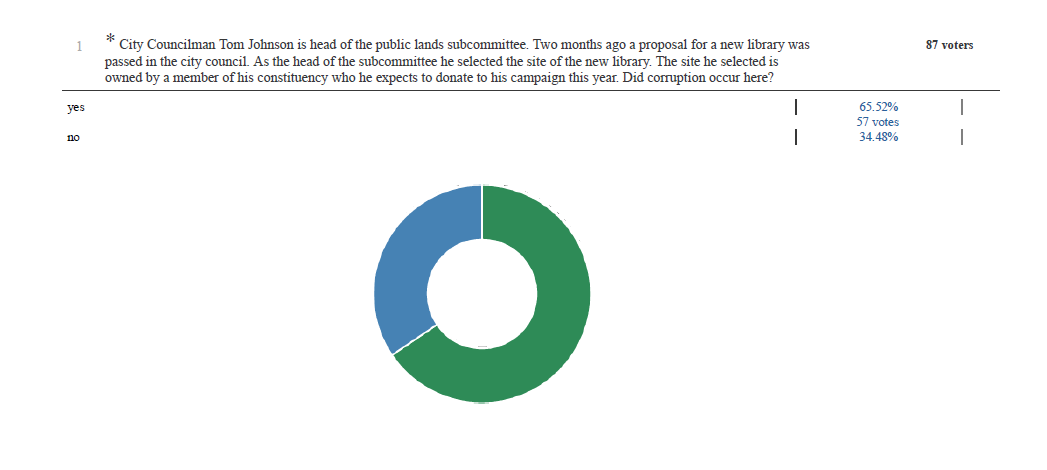
   The survey I created to test my hypothesis was an electronic survey with two scenarios of an ambiguous situation that could be construed as corruption.  The first question read as follows: “City Councilman Tom Johnson is head of the public lands subcommittee.  Two months ago a proposal for a new library was passed in the city council.  As the head of the subcommittee he selected the site of the new library.  The site he selected is owned by a member of his constituency who he expects to donate to his campaign this year.  Did corruption occur here?” The second question is almost identical, except for the fact that the politician is a fictional “Congresswoman Claire Woods.”
The survey that I distributed over 7 days had a total number of 87 respondents.  This smaller number presents the first limitation to my study.  In order to have an adequate margin of error, with 95% certainty, the sample size would have to be significantly larger than the sample I was able to draw.  Nevertheless, this sample is large enough to notice trends, despite its small size. It does not however allow for highly accurate conclusions to be drawn about a large population such as the US.
The second limitation is the relative homogeneity of the sample.  For example the respondents to the survey were 75% women and almost 90% were Caucasian.  Similarly over 60% self-identified as Republican in political orientation.  This is probably the biggest obstacle to my survey, as the emerging trends could possibly be heavily affected by biases of different racial and social groups.  I hypothesized that respondents to the survey would be more tolerant of a woman in a morally ambiguous situation than a man. 
My hypothesis was disproven in the results of the survey, as the response rates indicating corruption in the two scenarios did not vary to a degree large enough to be statistically significant. The perception of corruption is a more complicated relationship than a binary variable of male or female. Perceptions and biases are a cocktail of nature and nurture. Our different cultures and life experiences influence the way we perceive everything, including corruption. In the case of women and government, Beaman et al (2008) concluded that perceptions of women can be changed by exposure to women in government in places like India. This is just one example that shows the fluid nature of our conscious perceptions and biases. Due to the complex nature of perception, attempting to isolate the gender factor among others is extremely difficult. To conclude, in order to more perfectly identify the exact influences of gender on corruption perception, more information is needed to isolate and control for obfuscating factors like party identity, culture, social status etc. By controlling for these factors in a larger population, the magnitude of the effect would be easier to distill with greater certainty.


Sunday, April 10, 2016

Run the World: Do Women Reduce Corruption?


Corruption is a nasty thing. It has a detrimental effect on society in multiple ways. In the worst cases, corruption can cost lives. Short of death, corruption can cost people their freedom, money, and health. The effects of corruption can be divided into three main avenues: political, economic, and social.

From a political standpoint, corruption is a major threat to democracy and the rule of law. In a democracy, offices and institutions lost their legitimacy when they’re used for private gain. Not only is corruption damaging for established democracies, but corruption can seriously setback newly-evolved democracies. It’s difficult to develop strong democratic institutions and political accountability amidst rampant corruption.

Corruption causes numerous negative economic consequences: lower investment, lower GDP, greater income inequality, and budget distortions. It may also lower public sector quality and contribute to the rise of black markets and tax evasion. Corrupt politicians divert public resources to projects that will line their pockets rather than benefit the general population. These politicians also prioritize high-profile projects, such as dams and power plants, that more easily hide misallocated funds at the cost of vital government services like education and infrastructure. 

Finally, corruption erodes the social fabric of society. It undermines public trust in the political system, leaders, and institutions. Widespread disillusionment often leads to apathy and higher tolerance for corruption, making anti-corruption efforts more difficult.  

What’s a country to do?  

Despite real fears about corruption, people remain undecided about how to best combat corruption. Many anti-corruption measures succeed in the short-term, but ultimately fail to significantly alter behavior and accomplish lasting reform. In response, some scholars have proposed that women are less corrupt than men. Traditionally, society believed that women were inherently more moral and needed protection from the amoral political sphere. While this idea seems outdated and a bit demeaning, several studies show that men are more selfish and less risk-averse than women; both qualities are tied to corruption.

If women are less corrupt than men, then perhaps increasing women’s presence in government will reduce political corruption. Many activists and policymakers have seized onto this idea by demanding for gender quotas and more recruitment by political parties for women candidates. They claim that simply boosting women’s numbers will be enough to combat corruption. After all, women are the fairer sex.

I tested whether having more women legislators decreased corruption.

Using two measures of corruption, I ran statistical tests to see whether increasing women’s presence in the national legislature reduced political corruption within 183 countries. My data spanned a time period from 1995 to 2014. Since corruption isn’t confined to a specific region or continent, finding an anti-corruption policy that works throughout the world would be optimal for reformer governments and development organizations.

My study was divided into two parts. First, I tested whether the number of women legislators had a direct effect on political corruption; this test is called the TI basic model in the figure below. This test supported the earlier research with statistically significant results: greater women’s representation reduces political corruption. But it’s worth pointing out that the effect was fairly small.

Second, I retested the relationship between women’s representation and corruption, but I also accounted for other influences on corruption. This addition sets my research apart from previous studies since these studies often focused on either political or economic alternate explanations, but neither both. For instance, I included the influences of electoral rules and national wealth on corruption. In addition to political and economic variables, I also added a social influence on corruption: ethnic fractionalization. The results from the second part of my study are labelled TI and ICRG full models.


My analysis shows that higher women’s numbers have little, if any, effect on corruption. After accounting for other influences on corruption, the relationship between women’s representation and corruption almost disappears. In the figure above, the TI full model gave statistically insignificant results; the ICRG full model generated barely statistically significant results, but the ICRG index is an indicator of political risk rather than corruption. The difference between the two threats probably explains the finding.

The answer was not really.

I think my findings are more compelling than previous studies. Unlike previous studies, I account for a mixture of political, economic, and social influences on corruption. For instance, widespread income inequality makes struggling individuals easy prey for corrupt officials. Likewise, high literacy rates imply a more educated public which likely recognizes the harms of corruption and seeks to fight it.

Will higher numbers of women legislators truly reduce corruption? I don’t think so. My results suggested that women have a very small effect on corruption. A country would likely must add at least 50% more women to the legislature before seeing results. This shift would take multiple election cycles and seems impractical.   

Rather, public officials should focus on strengthening democratic institutions.

To fight corruption, governments should protect civil liberties and political rights. When government protects these two things, liberal democracies emerge from fairer societies. By their nature, liberal democracies reduce opportunities for corruption. Plus, increasing women’s representation in government becomes more important. The world needs anti-corruption policies that work in order to improve millions, if not billions, of lives. Women might not magically eliminate corruption, but governments can still benefit from their differing perspectives and experiences.